


 Tiếng Việt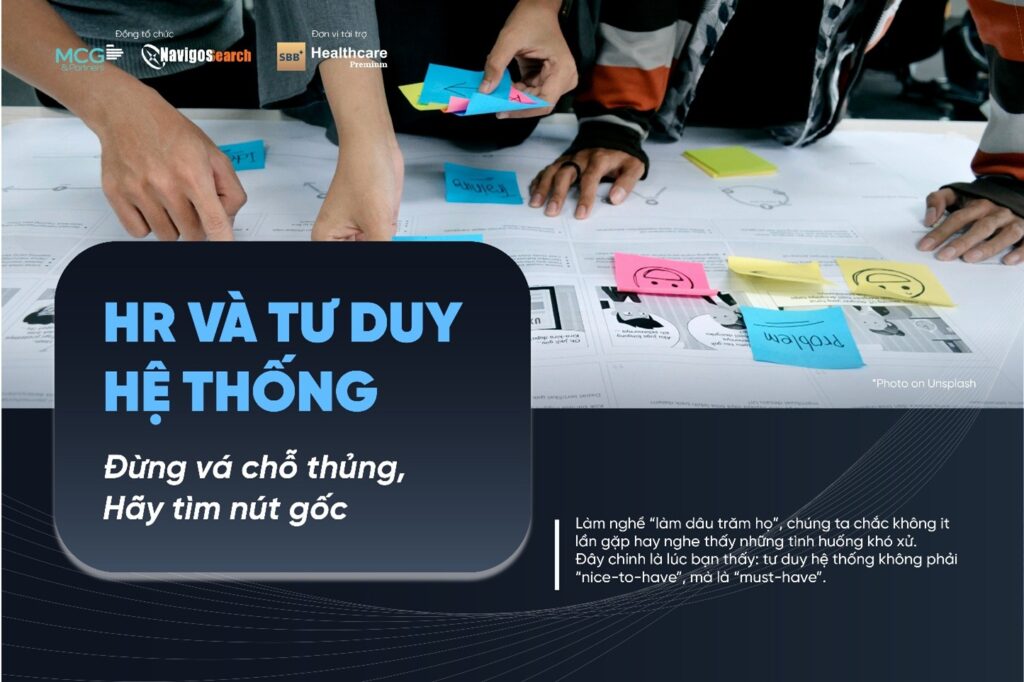
System-thinking does not turn you into a “company’s superhero”. Yet it helps you connect with your boss – challenge your boss – contribute solutions with data, logic and sustainable solutions.
A major contract runs into trouble; the client threatens to cancel. CEO asks, “Where’s the root cause?” Each department offers a reasonable answer… Yet the problem stays put. Organizations are like a tangled string of holiday lights: One point is touched, the whole strand flickers.
Systems thinking is the skill that untangles that strand – Connecting the dots across teams to locate the knot that truly needs loosening.
WHY SYSTEMS THINKING IS A MUST-HAVE IN HR
Working in HR often means being the go-between for many stakeholders. You’ve probably faced situations like these:
– Give one team a pay rise, and risk upsetting another
– Update a policy to better support employees, and trigger knock-on changes across related policies
– Rework KPIs to lift performance—and immediately hit a thicket of issues: unclear criteria, no baseline, and inconsistent interpretations across departments
That’s when you realize systems thinking isn’t a “nice-to-have.” It helps you look beyond surface symptoms to the web of relationships underneath—so you don’t just put out fires, you design solutions that are coherent and long-term.
• Rework KPIs to lift performance—and immediately hit a thicket of issues: unclear criteria, no baseline, and inconsistent interpretations across departments.
That’s when you realize system-thinking isn’t a “nice-to-have.”
Especially when you want to save your boss – instead of let the boss save you.
It helps you look beyond surface symptoms to the web of relationships underneath—so you don’t just put out fires, you design solutions that are coherent and long-term.
WHAT HIGH PERFORMERS DO DIFFERENTLY (3C)
They act like “internal detectives”:
• Catch what leaders really care about: Trace signals from data, employee stories, and customer feedback; assemble those fragments into a cause map that shows how issues connect.
• Challenge with evidence: Instead of “I think…,” they put the map on the table, point to the root drivers that matter.
• Contribute a path to resolution: They don’t default to firefighting. As they’ve already “caught” the leader’s pain points, they can propose a root-cause plan that addresses what the leader actually worries about.
Result? Leaders nod—not because HR is being oppositional, but because HR is helping them get out of the maze.
FOUR STEPS TO BUILD SYSTEMS THINKING—AND AVOID “FIX ONE THING, BREAK ANOTHER”
1. Observe: Gather enough data to see the whole picture before concluding 1-2 opinions. Tap multiple streams: HR dashboards, conversations with line managers, etc.
2. Connect: Turn fragments into a picture. Sketch quick relationships between drivers and effects—for example, an Ishikawa (fishbone) diagram: the spine is the problem, the ribs are cause categories. Once it’s drawn, you’ll see the issue never stands alone.
3. Check – Drill down to the root: Don’t stop at the first plausible cause. Ask “Why?” at least 3 times until you reach the true leverage point—”the knot”.
4. Pilot: When you believe you’ve found “the knot”, run a small, time-boxed pilot to validate that your solution is pointed in the right direction.
In incidents and escalations, the goal isn’t to make the fastest call—it’s to see through to the system underneath.
💡People with a systematic mindset don’t just extinguish fires; they shut off the fuel line.
Join our workshop “CONNECT – CHALLENGE – CONTRIBUTE: 3C TO WORK WITH YOUR BOSS” co-organized by MCG & Partners, Navigos Search and SBB Healthcare on 18.09.2025 for further information on this topic.