


 Tiếng Việt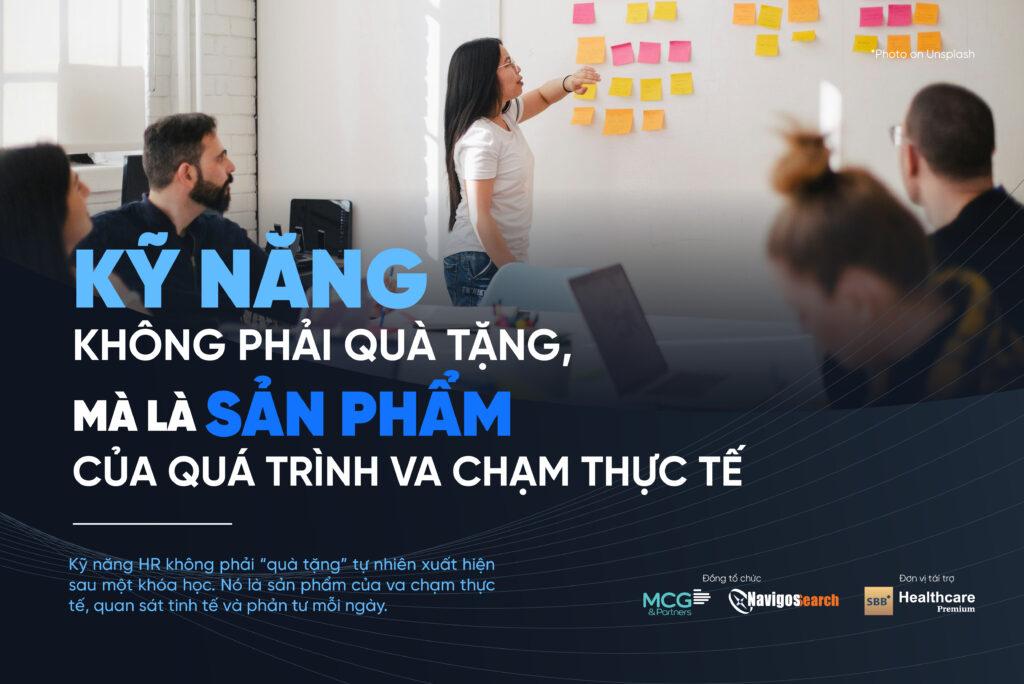
HR skills don’t magically appear overnight after a training course. They are built through real-world practice, thoughtful observation, and daily reflection.
Working in the people profession requires more than technical knowledge. Sharpening practical skills is just as important. Instead of asking “Which course should I take next?”, the sharper question is:
• What am I missing to understand my leader’s real problem?
• Can I push back effectively and respectfully when I see a gap in the solution?
• Am I helping my leader make the best call?
WHY DO WE KEEP LEARNING, BUT STILL FEEL SHORT ON SKILLS?
Last week, an HR Manager called me: “Do you know a problem-solving course I can take and use right away?”
That question made me pause. HR is full of situations that come with no warning:
• The CEO suddenly changes the workforce plan.
• A business head insists on hiring a “friend” without going through the process.
• A key talent unexpectedly resigns in the middle of a project.
In these moments, HR can’t flip through a textbook or ask for two days off to take a class. You need to act right away. Just like working out: reflexes and muscle strength only grow through exercise. We can try – fail – adjust – repeat. But we cannot “buy skills” instantly through a short course.
Just last week, I spoke with Như – an HRBP for Sales. Her company was scaling fast, Sales was pushed to hit +20% KPIs, and the Head of Sales wanted to bring in a “friend” as Sales Manager – no interviews, just fast-tracking. Như told me: “I know they need someone quickly, but if I say yes this time, they’ll expect the same again later.” Instead of flatly refusing, she walked through the process, explained pros and cons, promised to respect the final decision, and even shared a few strong profiles for comparison. In the end, the “friend” was still chosen – but through a transparent process. The Head of Sales felt respected, HR held the line on principles, and trust was strengthened.
TURNING KNOWLEDGE INTO REAL SKILLS
1. Name the problem correctly
Not every “conflict” is the same. Some are conflicts of interest (which can be negotiated). Others are conflicts of values (which may require deeper intervention, even policy changes). Mislabel the problem, and you’ll likely mis-handle it.
Understanding the root cause and naming it correctly is the foundation to “speak the same language” with leaders.
2. Learn what you actually lack
Many HR professionals think they need to “convince the CEO.” In reality, what’s often missing is the ability to ask strategic questions – so leaders themselves see the risks and adjust their decisions. That’s when HR truly “saves” the boss.
3. Observe and selectively copy
Learn persuasion from Sales. Learn storytelling from Marketing. The key is finding the right people, learning selectively, and applying it at the right time. Observation and cross-learning broaden your perspective, sharpen problem-solving, and strengthen your ability to debate constructively.
Skills don’t live in slides or textbooks. They grow through real-world encounters – trying, failing, fixing, and growing. By identifying what you lack, gaining “battlefield experience,” and learning from those better than you, you build lasting competence.
Learning for knowledge is quick. But building skills requires everyday practice – where each “tough case” is another rep in your HR gym. Great HR is not just about expertise, but about being able to:
• Connect with leaders: Sense what truly matters to leaders,
• Challenge with credibility: Speak effectively when needed, and
• Contribute practical options: Support with feasible solutions.
Join our Workshop “CONNECT – CHALLENGE – CONTRIBUTE: 3C TO WORK WITH THE BOSS” co-organized by MCG & Partners, Navigos Search and SBB Healthcare on 18/09/2025 for further information on this topic!